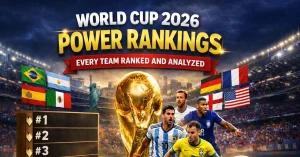
Ranking every team before a World Cup is always a challenge, but in 2026, it’s even more complicated.
With 48 teams involved, the gap between the strongest and weakest sides is wider than ever. At the same time, the expanded format increases unpredictability, meaning rankings are less about certainty and more about probability.
Still, looking at squad quality, recent form, and tournament experience, it’s possible to group teams into clear tiers, and that’s where World Cup 2026 predictions start to take shape.
Tier 1: The True Contenders
At the top of the rankings are the teams that realistically expect to win the tournament.
The France national football team sits firmly in this category. Their depth, versatility, and experience make them one of the most complete squads in international football.
The Brazil national football team also belongs here. Their attacking quality is unmatched, and if they maintain defensive discipline, they are capable of dominating any opponent.
The England national football team continues to evolve. With a balanced squad and improved tournament maturity, they are closer than ever to winning a major trophy.
And of course, the Argentina national football team, champions of FIFA World Cup 2022, remain one of the strongest teams in the world.
Tier 2: Strong Challengers
Just below the top tier are teams capable of reaching the final, but with slightly more uncertainty.
The Portugal national football team has one of the deepest squads in the tournament. Their ability to adapt tactically makes them a serious threat in knockout rounds.
The Netherlands national football team offers consistency and structure, often performing well in high-pressure matches.
Spain and Germany also fall into this category. Both teams are in transitional phases but have the quality and experience to challenge stronger opponents if they find the right balance.
Tier 3: Potential Dark Horses
These are the teams that may not be among the favorites, but could surprise everyone.
The United States men’s national soccer team stands out here. Playing across United States, Canada, and Mexico, they will benefit from home support and familiarity.
Other teams in this tier typically combine emerging talent with strong tactical systems. They may not dominate matches, but they are capable of taking advantage of opportunities.
Tier 4: Competitive but Unpredictable
This group includes teams that can compete but lack consistency.
They might produce strong performances in certain matches, but maintaining that level across an entire tournament is more challenging.
These teams often determine the outcome of the group stage and early knockout rounds. They can disrupt stronger teams and create unexpected scenarios.
Tier 5: Underdogs
At the bottom of the rankings are teams with limited expectations.
However, labeling them as underdogs does not mean they are irrelevant. In fact, these teams often bring the most unpredictability to the tournament.
With less pressure and more freedom, they can approach matches aggressively and take risks that more established teams might avoid.
What These Rankings Really Mean
Power rankings are not predictions in the strict sense, they are a snapshot of how teams compare before the tournament begins.
Form will change. Injuries will happen. Momentum will shift.
That’s why these rankings should be seen as a starting point rather than a final conclusion.
Key Factors Behind the Rankings
Several elements influence how teams are positioned:
Squad Depth
Teams with strong benches are better equipped for a long tournament.
Tactical Flexibility
The ability to adapt to different opponents is crucial in knockout football.
Experience
Teams with players who have competed at the highest level tend to handle pressure more effectively.
A Broader Perspective on Tournament Predictions
While power rankings help organize teams into tiers, they don’t capture every possible scenario.
For a more detailed view, including match projections, group-stage outcomes, and evolving team form, you can explore 👉 team predictions for World Cup 2026 to see how these rankings translate into actual tournament paths.
Final Thoughts
The 2026 World Cup is shaping up to be one of the most competitive tournaments in history.
The top teams remain strong, but the gap between tiers is narrowing. That creates more uncertainty, and more excitement.
Power rankings provide structure, but they can only go so far. Once the tournament begins, the real hierarchy will be decided on the pitch.
And as always, some teams will rise above expectations, while others fall short.